Friday, 30 March 2012

Conflict Resolution

Communal living with thirty monks isn’t easy. We may dress in a uniform way and don the same haircut, but you probably couldn’t find a more diverse group of people living in such close quarters. We have monks from five different continents, all with distinct personality traits, varied psychophysical natures and a unique approach to their spiritual development. As you can imagine, there are sometimes differences of opinion! But I guess relationships in any context come with their own complexities. Husband and wife, manager and employee, teacher and student, brothers and sisters, university house mates – where there are people there is bound to be friction. Forming genuine and deep relationships is thorny, complex and testing. But those relationships stand as the most valuable asset in our lives.

Recently, I have increased my meditation on developing tolerance, humility and appreciation, knowing that such traits are the key to connecting with people on a higher level. I am trying to develop broader mindsets and approaches in my day-to-day dealings. When someone’s actions anger me, I am trying to understand what is causing them to act in that way and what the hidden history is. Usually my anger subsides, and I gain greater insight into human emotions and responses. When someone falls short of my expectations, I am trying to reassess the legitimacy of my demands, and simultaneously appreciate whatever efforts and endeavours they have made. It helps put things in perspective, and offers hope for improvement and progression. When there is conflict, instead of running away in frustration and creating emotional distance, I am forcing myself to communicate and actively try to resolve differences. It can be awkward and humbling, but it’s good to talk.

I am coming to realize that the people around me, namely parents, friends, critics, mentors, and others, are not simply there by chance. Whatever the tensions, these are the people that providence has arranged for me to relate with, and these are the relationships that will help me develop into the person I want to become. I am trying to appreciate how everyone around me is having a contribution in my life. They all have the potential to create spiritual transformation within me, knowingly or unknowingly. I hope I will work through the difficulties, and not frustratingly opt out and gravitate towards impersonalism.

Thursday, 22 March 2012

One but different...

The Bhagavad-gita offers an interesting perspective on world religions. It explains how the various traditions all stem from a divine source, and all offer the potential of spiritual elevation. The differences between them are primarily in culture, ritual and expression, while the central principles remain universal. Since the same message was taught in different times, places and circumstances, the externals had to be adapted – essentially, old wine in new bottles. While many can resonate with such an idea, there are also students and practitioners who would find such a stance difficult to digest. How can we reconcile fundamental differences on philosophical points? How can we overlook striking contradictions in the various historical and cultural accounts? Could this be a naive ‘new age’ attempt to avoid confrontation and create ‘peace, love and unity’? Without a more detailed explanation, some may say it’s a case of politically correct, but theologically wrong. How do we rationalise differences between paths that supposedly stem from the same source?

Context – religious scriptures and statements must be understood in relation to the entire body of teachings, and also with due consideration of the social context within which they were presented. ‘Differences’ may be perceived because we adopt a one-dimensional approach; taking statements simplistically, without understanding the context, purpose and background behind them.

Emphasis – different traditions and teachers may stress different things. Our spiritual evolution requires complete refinement of character and consciousness, and different traditions may well work on different aspects of this. Thus, they may emphasise different points, but such ‘differences’ are a part of a broader harmony.

Interpretation – we understand the divine traditions through the representatives of that faith. While this is perfectly natural, the teachers do have to prove themselves as transparent via mediums, free from the propensity to insert their own ideas. ‘Differences’ may surface because we mistake human opinions as gospel truths.

Authority – any religious claims must be traceable back to the original texts. In today’s world much confusion ensues due to a lack of reference to authentic scripture and religious authority. People claim to speak for a tradition yet offer no reference point for their presentation. Thus, ‘differences’ may well be due to inaccurate and erroneous presentations.

This may provide some insight into why religious traditions are one, but simultaneously different...

Thursday, 15 March 2012

Sacred Space

Yesterday, 416 billion emails were sent by 2.4 billion Internet users. Yesterday, 786,000 television sets were sold, $196 million was spent on video games, and 576 million newspapers were circulated. Yesterday, $9.4 billion was spent on public healthcare, $8.5 billion on public education, and $6.3 billion on military and defence. There was nothing special about yesterday... it was just another day. The complexity of modern civilization is surely astounding, but simultaneously worrying since we are all impelled to complicate our own lives in order to survive in this climate. To a greater or lesser extent, everyone is forced to move with the times, monks included! It’s a far cry from the rural villages of bygone ages, where people moved much slower and spiritual culture was woven into the fabric of day-to-day life.

In a recent discussion with the Archbishop Rowan Williams, we reflected on the intrinsic worth of simple living. He shared an interesting story which I’ll attempt to paraphrase. Once, a young boy approached a local Bishop asking if he could be taught how to pray. The Bishop smiled and told the boy to sit down for five minutes while he finished other duties. When the Bishop returned he found the boy walking around the room and peering out the windows. As the boy sighted the Bishop he repeated his request. The Bishop compassionately looked at the boy and said “I can teach you how to pray, but first you have to learn to sit quietly, speak quietly and eat quietly.” The Bishop left, and the boy was left with some food for thought. Truth be told, to sit silently for 10 minutes would be an uncomfortable and unnatural experience for many of us. However, that quietness is essential – we all live, but do we live consciously.

Stillness, serenity and simplicity were the key messages of the Bishop. Noisy, loud and boisterous environments; opulence and excessively luxurious habits; stressful, demanding and taxing lifestyles – these can all clutter our consciousness, and block one from accessing higher wisdom and spiritual ideals. Unfortunately, the reality is that modern spiritualists are faced with such things on a daily basis. They’re inescapable. Thus, great teachers instead recommend that everyone create a sacred space in their life; a place of retreat, a place of clarity, a place of inspiration. Every day, the spiritualist can make a concerted effort to spend quality time in their sacred space to reflect, refocus and rejuvenate. The sacred space facilitates their meditation on the deeper meaning. This space provides the necessary quietness in an otherwise madly passionate society. It’s the place from where we prepare to face the world, and it’s the place where we return for sanctuary.

Sunday, 4 March 2012

What’s in a Word

Someone recently questioned why I post and publish my own writings. Surely ancient texts like the Bhagavad-gita have already distilled the essential truths for mankind. Can our insights and understandings significantly add anything to that? Could this extra information simply divert people from going to the original source? Is it not a little proud and presumptuous to think our explanations could be clearer than the divine word? I felt my defenses going up, and a thousand arguments began to circulate in my head, but I resisted confrontation and patiently listened. It was an opportunity to reassess. After all, it is a grave responsibility to re-present the teachings of great spiritualists and distinguished thinkers. One requires genuine purity and freedom from worldly ambition. 

Writing may be seen as an exercise in self development. It’s an opportunity to crystallize thoughts and test comprehension since explaining subject matter necessarily entails that one have a good understanding of it first. While communicating universal spiritual truths, our own weaknesses, faults and deficiencies become strikingly apparent. Scribing our thoughts on paper can reveal the mysteries within. It also helps one to become more conscious of the world around them. Everyday occurrences, interactions and conversations are pregnant with insightful life lessons. Being in writing mode helps one to tune in. We may read wisdom in a book, but we see it in action in the real world.

OK, but why publish such writings? When Swami Prabhupada first arrived in New York, he published his magazine “Back to Godhead” and repeatedly insisted that every issue contain articles written by his students. He was concerned that ancient truths be carried into the modern context in suitable language and with reference to the contemporary needs, interests and concerns of the world. Swami Bhaktivinoda, another prolific writer, explained how many people simply study books, collect information and then store those facts, like a magistrate imprisons a criminal in jail. He labelled it “fruitless retention.” Rather, he said, one should take such knowledge, apply it in one’s life, and then creatively share it according to personal experience and taste. Thus, our writings are not a challenge to the great teachers, but rather a humble attempt to fulfil their wishes, and in some insignificant way encourage people to excavate the ancient writings for their own transcendental gems.

Tuesday, 28 February 2012

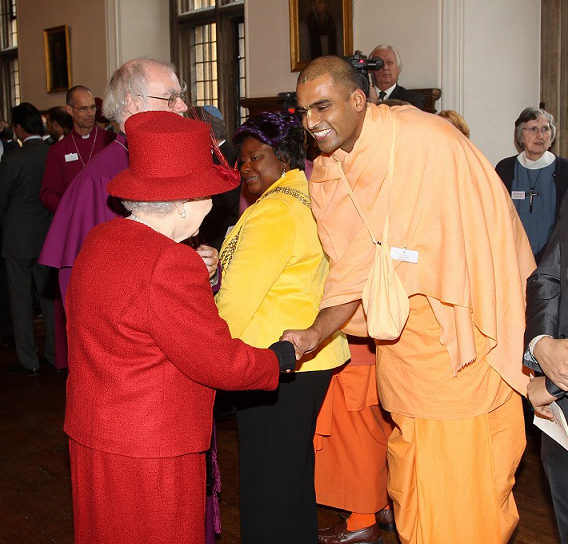
A Royal Meeting


Last week I had the good fortune of meeting Her Majesty The Queen and His Grace the Archbishop of Canterbury. A multi-faith reception was held at Lambeth Palace; one of the first public engagements to celebrate the Queen’s Diamond Jubilee year. The event was attended by representatives from the Christian, Baha'i, Buddhist, Hindu, Jain, Jewish, Muslim, Sikh, and Zoroastrian communities. It was an opportunity to pay tribute to the spiritual contribution of all religions in the UK, and to show continued support for the free practice of faith in the country.

The Queen expressed how spiritual traditions provide critical guidance for the way we live our lives, and for the way in which we treat each other. She wonderfully underlined how the lives of great teachers remind us of the responsibilities we have beyond ourselves. As I spoke to the leaders of various denominations, our discussions revolved around making spirituality applicable and dynamic in the modern context. In an age of growing secularism, there are doubts about the necessity of spirituality as an integral part of a vibrant society. It is sometimes seen as sentimental and unscientific, and on a social level often divisive and provocative. Others argue that ancient teachings are outdated and irrelevant, and function simply to give people a sense of identity and social belonging.

Amidst this tide of skepticism, spiritual practitioners have an incredible responsibility to share their teachings with greater acumen and astuteness. Through rationality, logic and common sense, they have to reveal the synthesis between science and spirituality, and firmly establish that metaphysical phenomena can be grounded in reason and argument. Through cooperation, appreciation and loving relationships, they have to demonstrate that genuine spirituality builds bridges, serves society in times of need, and promotes peace and unity. Through sagacity and dialogue, ancient traditions must offer cutting edge spiritual solutions to the problems of the modern world – solutions which are universally applicable, long lasting and free from detrimental side effects. Most essential, is to educate and inspire people to recognize that spirituality is more than a Sunday ritual, but rather an offer of worldviews, values, and spiritual practices which drive our daily functioning and journey within this world.

I walked away from Lambeth Palace with a greater sense of purpose. We definitely have our work cut out.

Sunday, 26 February 2012

Servant Leaders

The Bhagavad-gita is found within the ancient epic “Mahabharata”, famed as the longest poem in the world with over 100,000 verses. It contains numerous passages which are not only captivating but simultaneously instructive and insightful. In one such episode, the devoted Queen Kunti is faced with a quandary. Presently childless, she is fully aware of the urgency to beget offspring who can continue the family lineage and subsequently become the future leaders of society. Unfortunately, her husband Pandu has been cursed to die the moment he engages in sexual union. To solve the dilemma she invokes a divine boon and summons the heavenly gods to impregnate her by dint of their mystic potency. The sons produced become known as the “Pandavas”, the emblems of spiritual leadership.

Kunti first called upon the god of Judgement, Yamaraja. Consequently, the son Yuddhistira was born who was considered exemplary in morality, truthfulness and integrity. Next she summoned the god of wind, Vayu. From him, the son Bhima was born, who was famed as an embodiment of strength, vigor and power. Thirdly, she called upon the god of heaven, Indra. The outcome of that union was the famed Arjuna, who was a personification of devotion, spirituality and divine faith. A closer look reveals that Kunti strategically chose the heavenly gods to produce sons who would be fully qualified to guide society.

Leaders must embody these three qualities. They must have strength – the ability to make bold decisions, maintain clarity under pressure, show courage in daunting situations, and be willing to lead from the front. This strength needs to be tempered with morality – knowing the difference between right and wrong, being sensitive to human feelings, and showing maturity and awareness of the ramifications of each decision. However, both qualities must be founded upon a deep spiritual basis. Leaders who have this profound element to their character stand out – their ornaments are humility, compassion, incredible tolerance, positivity and unshakable faith. They function as servant leaders, uninterested in personal fame and selfish gain, but instead completely focused on bringing out the best in others. As Abraham Lincoln said “it’s amazing what you can achieve when you don’t care who gets the credit.”

Friday, 17 February 2012

Are you Buddhist?

For many people a shaved head plus orange robes equals a Buddhist. At least that’s been my experience as a traveling monk. While the Buddhist and Vedic path are two distinct schools, they do share many things in common. The teachings, culture and spiritual practices bear striking resemblance to each other, and the ways of thought and action are both intriguing. Interestingly, followers of the Vedic tradition accept Buddha as an incarnation of Krishna, the speaker of Bhagavad-gita. The Buddha’s life and teachings are discussed in numerous passages of the Vedic texts, where his mission, contribution and spiritual achievements are expounded and predicted.

Fundamental meditations in Buddhism awaken one to the unpleasant facts of life, the nature of this world, and the reality of suffering. In the Buddhist teachings we find particular emphasis on the development of saintly qualities such as nonviolence, compassion and truthfulness. Buddhist texts describe how the root of suffering is found within the powerful material desires embedded in our hearts. The Buddha talked of karma, reincarnation, and transcending samsara (cycle of birth and death) through mind and sense control. The very same teachings are elucidated within the Bhagavad-gita and other Vedic texts. Followers of both traditions work at quieting unnecessary passions or desires, and instead cultivating desires of the spirit, pursuing the passion for truth.

So is there any difference? For Buddhists, nirvana, or cessation of material existence, is the goal. In the Bhagavad-gita, however, Krishna explains that relief from distress is only an intermediate stage on the path, but that spirituality ultimately evolves into positive emotion and action. One path is likened to awakening from a bad nightmare and experiencing relief and freedom. The other path encourages one to get up from bed, and go on to experience life to its fullest extent.  As Buddhism focuses on escaping this material world, the Bhagavad-gita talks of entering the spiritual world. That world is known as Vaikuntha, the place of no distress, but also the place where every word is a song, every step is a dance, every action is selfless, and every relationship permeated by love.

Wednesday, 1 February 2012

The road less travelled

Last week I drove into Central London at 4.00am. It was refreshing - no cars, no traffic jams, no stress. Unfortunately it didn’t last very long. Cruising toward my destination I unexpectedly encountered major roadworks and got stuck in a huge tailback. Despite the strategic timing of my journey, I still ended up delayed! It reminded me of the challenges encountered in our early morning spiritual practices. Every day we dedicate the two hours around sunrise to focused personal meditation. Through the process of mantra, we whisper sacred names of Krishna and try to conscientiously hear that transcendental vibration. Attentive aural reception frees the mind, cleanses the heart, and brings one in contact with the spiritual reality. You simply have to focus on the vibration. Nothing else. Sounds simple, but in practice is quite problematic since the mind is notoriously difficult to control. One thought leads to another, which leads to a third, and soon we are drifting off and straying far from our purpose.

The early morning hours are considered the most conducive for spiritual practice since the mind can peacefully flow toward the spiritual goal. However, just as early morning road works slowed down my car journey to London, mental agitation can similarly inhibit the strength of one’s spiritual connection. As I sat down this morning in preparation for my chanting, a million things were going through my mind. There were doubts and uncertainties about pending situations. There were quarrels and conflicts of opinion on pertinent issues. There were worries about friends and pressures of expectation from respected associates. There was also excitement about future opportunities, a sense of pride at this week’s achievements and anticipation at the day ahead. What can I say... the mind is a busy place! How in the world would I be able to put this all to one side, pacify the mind, and concentrate on the task at hand – to simply hear the mantra and focus on the spiritual reality?

I tried to cultivate a broader mindset. Everything in my life can be resolved if I deepen my spirituality. The problem is not other people – but it’s actually my lack of tolerance, empathy and sensitivity. The problem is not the situations I find myself if in – but it’s actually my rigidity, stubbornness and lack of broader vision. It even occurred to me that all my aspirations and dreams can manifest beyond my imagination, but only after I fine tune my motivations and eradicate my ulterior selfish motivations. Everything is coming from spiritual purity, and spiritual purity is coming from determined and focused spiritual practice. As I sat down I thought to myself - “let me just focus on this mantra for the next two hours; after that, life will look quite different; situations and perspectives will change.” It worked. Bucket loads of mental energy saved, and real solutions found. I’ll try the same tomorrow. Wish me luck.

Twitter Delicious Facebook Digg Stumbleupon Favorites More

 
Design by Free WordPress Themes | Bloggerized by Lasantha - Premium Blogger Themes | 100 Web Hosting